Neural Networks in Plain Language
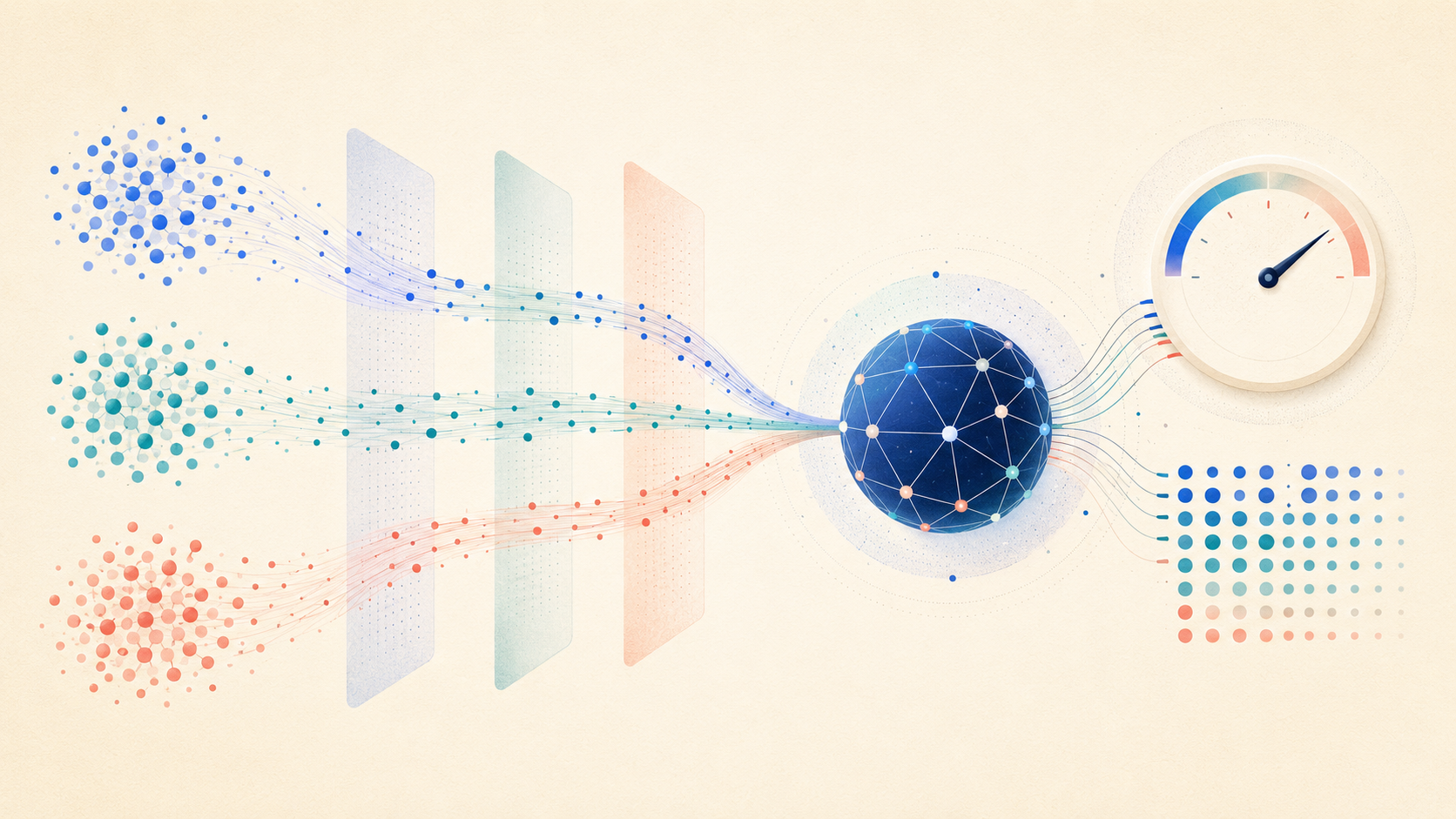
A neural network is a flexible mathematical function built from connected layers. During training, it adjusts many numerical weights so that inputs produce useful outputs.
Learning objectives
What you will be able to do
- Explain neural networks in plain language accurately in your own words.
- Recognise how the concept appears in real AI products and professional work.
- Identify an important limitation, risk or evaluation requirement.
- Apply the concept through a practical activity and knowledge check.
Core explanation
Build the right mental model
Each unit combines incoming values, weights and a bias, then applies an activation function. Layers allow the network to build increasingly useful representations—for example, edges, shapes and objects in an image.
Backpropagation efficiently calculates how each weight contributed to error. An optimiser then makes small weight updates. Repeating this process over many batches gradually improves performance.
The brain metaphor is historically influential but limited. Artificial neural networks are engineered mathematical systems, not replicas of human cognition.
Weight
A learned value controlling the influence of one signal.
Activation
A non-linear transformation enabling complex patterns.
Layer
A stage that transforms one representation into another.
Backpropagation
A method for calculating how parameters should change to reduce error.
Recognising handwritten digits
Pixels enter the network; hidden layers build representations; the output layer estimates the probability of each digit.
Apply your learning
Practical activity
- Sketch an input layer, two hidden layers and an output layer.
- Label what each could represent in an image classifier.
- Explain why a non-linear activation is needed.
Write your answers in a learning journal. The value comes from connecting the concept to your own profession.
Knowledge check
Test your understanding
Q1What is learned during neural-network training?
Answer: Primarily the network’s weights and biases.
Q2Is an artificial neuron a biological neuron?
Answer: No. It is a simplified mathematical processing unit inspired loosely by biological terminology.
If you cannot explain the answer without reading it, revisit the core explanation and example before continuing.
Continue with authoritative sources
Important industry resources
These links lead to official organisations, industry laboratories or established open-source learning projects.