Unsupervised Learning Fundamentals
Unsupervised learning looks for structure in data without being given a correct label for every example.
Learning objectives
What you will be able to do
- Explain unsupervised learning fundamentals accurately in your own words.
- Recognise how the concept appears in real AI products and professional work.
- Identify an important limitation, risk or evaluation requirement.
- Apply the concept through a practical activity and knowledge check.
Core explanation
Build the right mental model
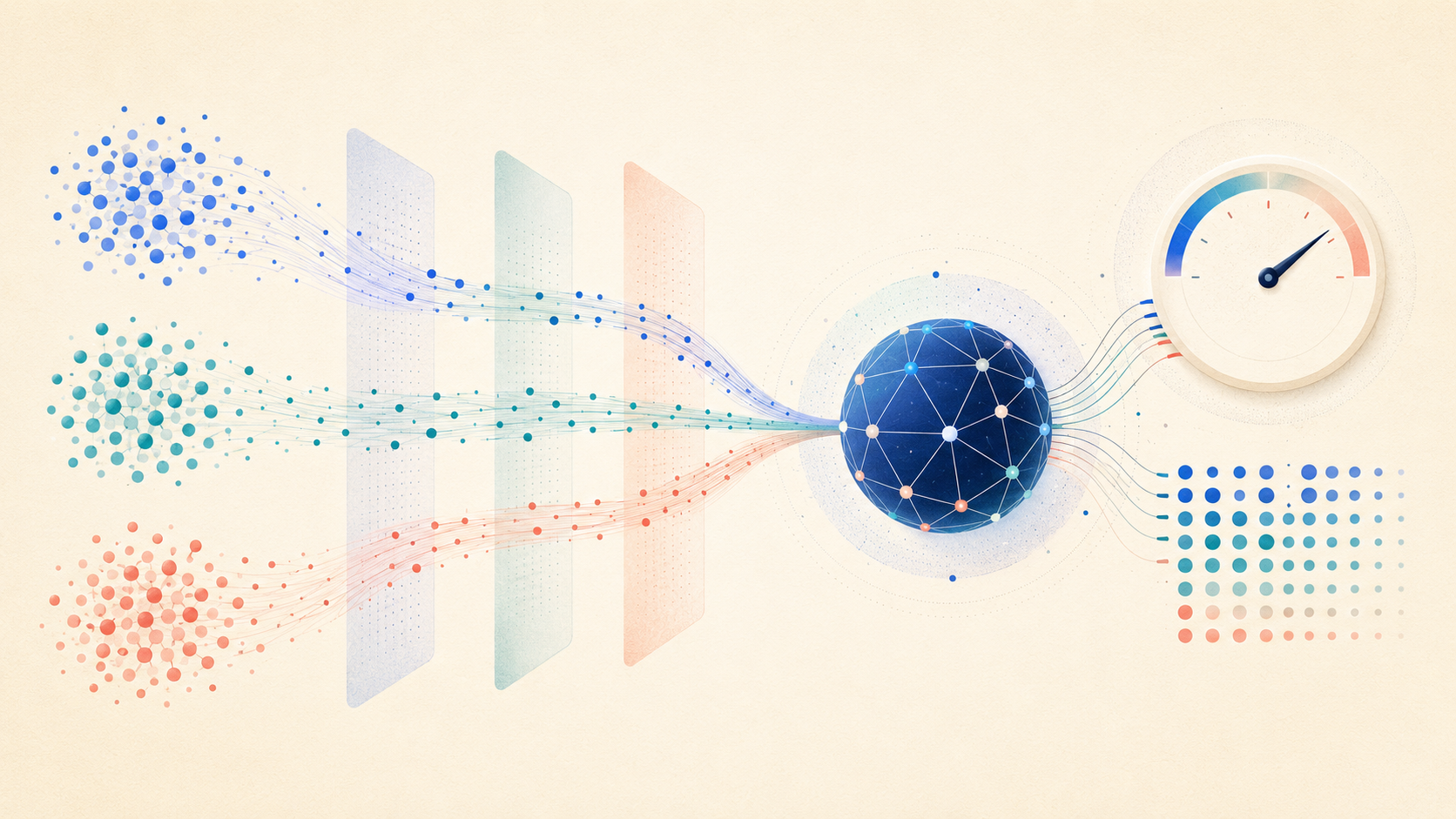
Clustering groups similar records, dimensionality reduction creates simpler representations, and anomaly detection identifies cases that differ from the norm. These methods help explore data and generate hypotheses.
A cluster is a mathematical grouping, not automatically a meaningful real-world category. Analysts must inspect what features drove the separation and whether the grouping is useful, stable and fair.
Unsupervised results often become inputs to human investigation or later supervised models. They should not silently become high-stakes decisions.
Clustering
Grouping examples according to a chosen measure of similarity.
Dimensionality reduction
Representing complex data with fewer informative dimensions.
Anomaly detection
Finding examples that differ strongly from expected patterns.
Interpretation
Connecting a mathematical pattern to a defensible real-world explanation.
Network traffic discovery
Clustering reveals groups of devices with similar communication behaviour and isolates an unusual host.
Apply your learning
Practical activity
- Choose a dataset with no labels.
- List three features that express similarity.
- Describe what a useful cluster would mean.
- Write one alternative explanation for an outlier.
Write your answers in a learning journal. The value comes from connecting the concept to your own profession.
Knowledge check
Test your understanding
Q1Does unsupervised learning prove why groups exist?
Answer: No. It reveals mathematical structure; domain experts must interpret and validate its meaning.
Q2Give one unsupervised task.
Answer: Clustering, dimensionality reduction or anomaly detection.
If you cannot explain the answer without reading it, revisit the core explanation and example before continuing.
Continue with authoritative sources
Important industry resources
These links lead to official organisations, industry laboratories or established open-source learning projects.